

Citizen Science Lab founder talks with South Fayette students
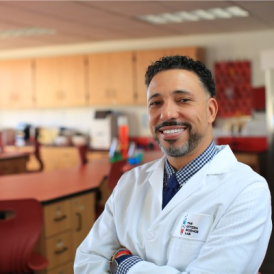
Anyone who has ever struggled with a quadratic equation or a Bunsen burner can take comfort in the knowledge that Andre Samuel once failed microbiology and chemistry classes.
However, that didn’t prevent him from ultimately earning a doctorate in biology at Duquesne University and founding and leading the Citizen Science Lab. The Citizen Science Lab is designed to help students in disadvantaged communities learn about the STEM fields of science, technology, engineering and mathematics. One location is in the Landmark Building in Bethel Park while another is in the works in Pittsburgh’s Hill District.
“I didn’t like science classes, though I liked science,” Samuel said. He talked about his life and work at South Fayette High School on Feb. 12 for a Black History Month event sponsored by the school’s SHOUT (Social Handprints Overcoming Unjust Treatment) organization.
An aversion to science classes wasn’t the only hurdle facing Samuel – the product of a broken home, he had a tough upbringing in Washington, D.C., where addiction and “sleeping on the streets” were part of the picture. He cites Thanksgiving morning in 1995 as the day he woke up “from a terrible binge” and decided to point his life in a newer and healthier direction.
“Hip hop and ‘Star Wars’ kept me grounded,” according to Samuel. “There were rap artists who had messages of advancement for people of color. … I identified with the dark side and the Force. I would often say to myself, ‘Don’t fall into the dark side.'”
Samuel eventually earned a biology degree at the General University of the District of Columbia, then another degree from George Washington University in genomics and bioinformatics, both fields that involve the study of DNA. He received his degree from Duquesne after moving to the area in 2004 when his wife started attending the University of Pittsburgh Law School. They were here on a “three-year plan,” Samuel noted, but “we’ve been here ever since.” As a scientist, his specialties include the development of a vaccine for hookworm, the toxicology of certain drugs and the reactivation of tuberculosis in nonhuman primates.
In 2015, Samuel founded the Citizen Science Lab with the idea that children – particularly those who might not have considered a career in the sciences – would have access to a laboratory and tools close to where they live. The South Hills location has multiple labs, and last April ground was broken for a $5.8 million facility in the Hill District on the site of what had been the Martin Luther King Jr. Reading and Cultural Center. Once it’s completed, it will be called the MLK Center for Scientific Excellence, and will have a space for drone aviation, public art spaces, quiet study spaces, a greenhouse and more.
Samuel emphasized the importance of connecting with other people throughout a career.
“Networking is a huge part of your success,” he said. “Networking got me the half-million dollars to start the Citizen Science Lab.”
He did recently take a three-month sabbatical, but Samuel said he is still very much committed to the Citizen Science Lab.
“I never considered not going back,” Samuel said. “I came back fired up. I’m not going anywhere. It’s very hard to leave what you built yourself.”